By The Discover the Odds Team
Updated March 23, 2026
It’s a scene straight out of a classic movie: a character orders a plate of fresh oysters, shucks one open, and discovers a perfectly round, gleaming pearl nestled inside. This romantic notion has led many seafood lovers to hopefully inspect their half-shells before slurping them down. But what are the actual chances of this happening? While it’s a fun thought, finding a valuable pearl in your dinner is less of a lucky break and more of a biological miracle.
Contents
The Long Shot: Uncovering a Natural Pearl
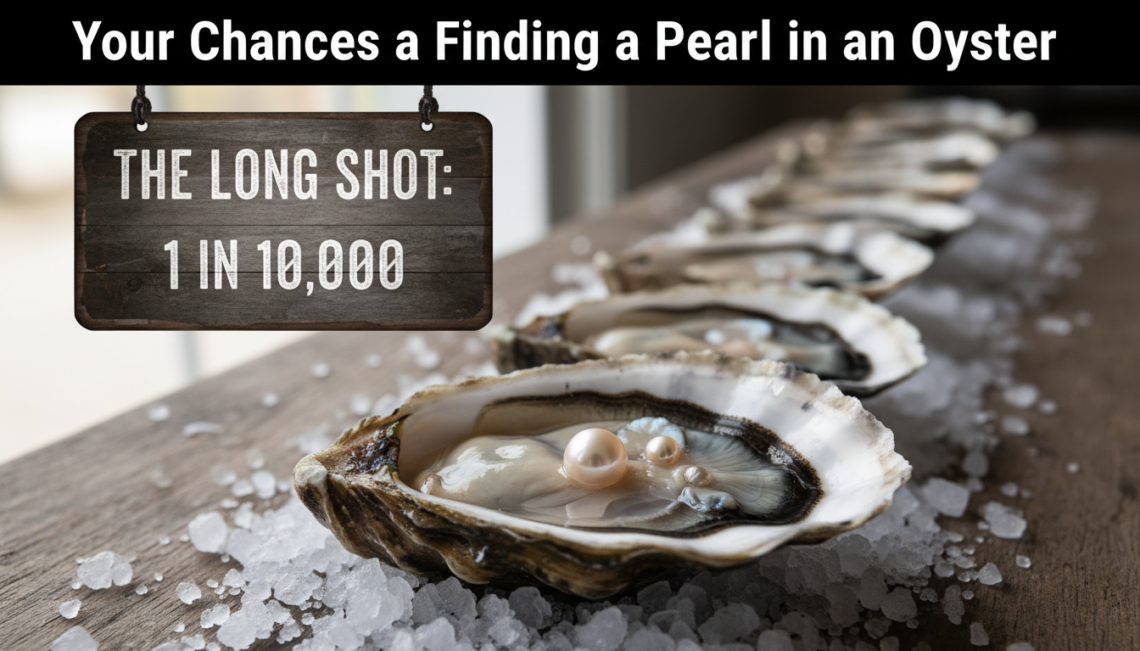
The most commonly cited statistic is that the odds of finding a natural pearl in an oyster are about 1 in 10,000. While that number itself sounds daunting, it doesn’t even tell the full story. This figure specifically applies to pearl-producing oyster species, not the kind you’d typically find on a restaurant menu. Hitting these odds means you’ve found a pearl, but it says nothing about its size, shape, or quality. The chances of finding a gem-quality pearl—one that is round, lustrous, and large enough for jewelry—are astronomically smaller.
A natural pearl is formed when an irritant, usually a tiny parasite and not a grain of sand as myth suggests, becomes trapped inside the mollusk’s soft tissue. To protect itself, the oyster begins to secrete layers of a substance called nacre, also known as mother-of-pearl. Over several years, thousands of these microscopic layers build up around the intruder, slowly forming a pearl. This process is a complete accident of nature; it’s a defensive response that only happens under very specific and rare circumstances.
Even if you are that one lucky person in 10,000, the “treasure” you find might not be what you envision. The vast majority of natural pearls are not perfectly spherical. They are often irregularly shaped, known as “baroque” pearls, or very small. Furthermore, many lack the iridescent luster that makes pearls so valuable. Finding a natural pearl is one thing, but finding one that a jeweler would consider a precious gem is like winning the lottery twice in a row.
Why Your Dinner Oyster Likely Won’t Have One
A major reason your culinary adventure is unlikely to yield a treasure is that we eat different oysters than the ones that produce gems. The delicious oysters served on the half-shell, such as Pacific, Kumamoto, or Atlantic oysters, belong to the Ostreidae family. These are “true oysters” farmed for their succulent meat. While they are capable of producing a form of concretion, it is not a true, nacreous pearl. It’s typically a small, brittle, and lusterless calcareous deposit with no real value.
The beautiful, high-quality pearls used in jewelry come from an entirely different family of mollusks known as Pteriidae, or “pearl oysters.” Species like the Akoya, Tahitian, and South Sea pearl oysters are farmed specifically for gem cultivation, a process that results in cultured pearls. Their meat is generally tougher and less palatable, so they aren’t part of the global food supply. Essentially, the oyster industry has two distinct branches: one for food and one for gems, and they rarely, if ever, overlap.
So, should you give up the hunt? Not necessarily for the fun of it, but it’s important to manage expectations. The oyster on your plate was bred for flavor, not for producing gemstones. Think of it this way: you wouldn’t expect to find a diamond while digging for potatoes just because they both come from the ground. Enjoy your oysters for the culinary delight they are. If you happen to bite down on something hard, you’ll have a fun story to tell, but you likely won’t be paying off your mortgage with it.
In the end, the fantasy of finding a pearl in a restaurant oyster is just that—a fantasy. The odds are incredibly slim, the biological process is a fluke, and most importantly, the oysters we eat are from a completely different family than their gem-producing cousins. The real treasure is the fresh, briny flavor of the oyster itself. So, by all means, keep looking, but don’t let the hunt for a long-shot treasure distract you from the guaranteed prize on your plate.